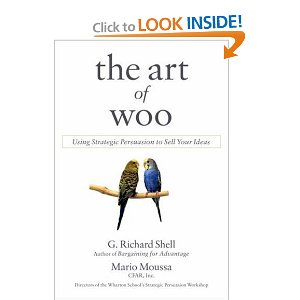
 Last week I wrote an article about persuasion as a process, in which I emphasized the critical importance of preparation and positioning before you get in front of your intended audience. I’ve chosen The Art of Woo for this week’s book recommendation for the lessons it includes about strategic persuasion. (more…)
Category: Persuasive communication
-
Book Recommendation: The Art of Woo
-
Free Your Hands

 There was a FedEx commercial where a low-ranking employee suggests opening an online account to save shipping costs. No one responds. A few seconds later, the boss says exactly the same thing, only this time using emphatic gestures. Everyone cheers and adopts the solution. When the young guy points out that he suggested the same idea, the boss says: “But you didn’t go like this”, as he karate-chops the air.
That scene may be a bit exaggerated, but the fact is that many speakers unconsciously disarm themselves by imprisoning their hands while they speak. They lose the effectiveness that gestures can contribute to the effectiveness of any presentation or conversation by supplying information, authenticity, and energy. (more…)
-
Persuasion Without Drama: Process, Positioning and Preparation

 We all admire the heroic view of persuasion, where the hero deploys his impeccable reasoning, formidable personality and eloquent words to sway an audience. Think 12 Angry Men, or Win One for the Gipper, or, for the more literary-minded, Mark Anthony’s eulogy for Caesar, where he artfully turned the anger of the mob away from Caesar and against his murderers. It’s easy to be fascinated, because that’s where the drama is.
But the most effective persuaders in the long run usually do it without the dramatics. They understand that, in the words of Sun Tzu, the best general is not the one who wins the most battles, but the one who wins without having to fight battles. (more…)
-
How To Present Technical Information Effectively
 They say an expert is someone who learns more and more about less and less until finally he knows everything about nothing. I’m not sure if that’s true, but many of the senior executives I speak with come away from encounters with experts feeling they’ve been told a lot but still understand nothing.
One of the most common issues that I am asked to address in my coaching sessions is how to communicate complex and difficult information to a lay audience. My coaching clients, who include engineers, scientists, and lawyers, sometimes understand on their own that they take too long to express their ideas, and are frustrated by it. More often, they’ve been counseled by others that they must be more concise and clear. As one senior person in a high-tech company told me when he hired me to coach his staff: “I ask people what time it is, and they tell me how to build a watch.”
The real issue is not in making your listeners understand—it’s how to help them get it efficiently. (more…)