Category: Persuasive communication

  • The Frame Is As Important as the Picture

    Start here and then fill in

    I’m not an art expert, but I think it’s safe to say that painters paint the picture first and then worry about the frame. In persuasive communications, you need to do the opposite: choose the frame first and then paint your word picture. If you manage the frame, you manage the message.

    A frame is simply a point of view, or a perspective to take on a particular situation. People have long known, and psychologists have recently confirmed, that changing perspective can change conclusions drawn and the choices made. In one disturbing example, even physicians were more apt to recommend a procedure with a 90% survival rate than one with a 10% mortality rate. You probably would not consider it fair if a store told you that you had to pay a surcharge for using a credit card, how we look at the decision has a significant—often decisive—effect on the final decision. Expert persuaders pay as much attention to the frame as they do to the objective facts.

    Frames are so powerful because your mind doesn’t process all the millions of bits of information that simultaneously bombard your senses; it simply can’t. And, even if it could, it would not be the most efficient use of brainpower and time: our ancestors survived long enough to pass on their genes to us because in emergencies they were able to focus on a limited—but correct—set of the incoming information. When we “choose” what to attend to, we exclude a vastly larger set of information. We each see the world through a limited “window”, whether or not we’re aware of why we choose that particular point of view at the time. That’s why several people can view a scenario and come away with very different perceptions and interpretations of what happened.

    So many different frames to choose from                                                                    

    Let’s visit the frame shop and see what a rich array of choices we have for framing our arguments for maximum persuasive effect:

    Positive/negative framing: In a nutshell, people are more likely to take risks and incur costs than to achieve gains. In an example I’ve written about before, about ¾ of respondents choose one decision when it is framed one way, and ¾ choose the exact opposite decision when it is framed another way. The effect is so strong that even when I use the example in my classes, many of the participants reverse their preferences even when they know there is no objective difference! If you were mulling over an investment that could make your company more competitive, do you suppose it might make a difference if you focused on the possibility that your competitor might implement it before you do?

    This doesn’t mean all your messaging should be framed in a negative way. If the other person has already decided to do something, but not necessarily what, frame the what positively—they’re much more likely to buy the 90% lean beef than the 10% fat.

    Identity framing: This is one of the strongest frames because it draws on intrinsic motivation. Everyone sees themselves in a certain way, and seeks to act consistently with that picture. In his book, Primer on Decision Making: How Decisions Happen, James March tells us that when confronted with a decision, people make a rapid unconscious calculation that answers these questions: What kind of situation is this? Who am I? What does a person such as I do in this type of situation? It also works at the organizational level. Last year, when I had a billing dispute with the local hospital authority, I quoted from their values statement on their web site in my letter to the CEO, and got immediate and complete satisfaction.

    Fairness framing: The need for fairness is so ingrained in our psyches that we will often hurt ourselves just to punish someone we perceive as acting unfairly. But what is perceived as “fair” is extremely subjective, as this scenario illustrates. You’re thirsty while sitting on the beach on a hot day. Your friend offers to pick up a beer for you at the swank beach-side hotel bar a block away. How much would you be willing to pay for the beer? What if he was going to buy the beer at a run-down grocery store? Would that change how much you’re willing to pay? Most people would pay $5 or more in the first instance, but not above $2 in the second. Keep in mind that it’s the same beer, and they are going to drink it in the same place, but for some reason the higher price seems fair in one scenario but not the other.

    Goal framing: There’s an old saying that where you stand on an issue depends on where you sit. The people you are trying to persuade will evaluate your message in relation to the goals they are trying to accomplish. Suppose you are selling an idea that will reduce your customer’s cost of goods by 5%. How would you position it? Most people in my classes tell me they would stress the impact of cost savings on the bottom line. But if the company’s stated business strategy is to increase market share, the more effective frame might call for applying the cost savings to price reductions, and this would change the entire focus of your sales strategy, including who you approach.

    In the interest of brevity, I’ll cover several other excellent frames in a future article, including analogies, narratives, and contrast effects, so for now, let’s consider what this means to you as salespeople and/or general persuaders.

    With so many different frames to choose from, how do you figure out the best approach? First, you have to know your audience so well that you can figure out how they’re currently framing the decision and which frame will most resonate. If they match, great—express your idea within that frame, if possible. If they don’t, figure out how to change their frame. Once you’ve selected your frame, that’s when you paint your word picture: just make sure everything you say is relevant and consistent within that frame.

     

  • Time to Put the Learning Styles Myth to Rest

    One of the most widely-held beliefs about presentations and about learning is the idea that people have a preferred learning style—auditory, visual, or kinesthetic—so students learn more when the lesson is delivered in their learning style. A study cited in yesterday’s Wall Street Journal found that 94% of secondary school teachers they surveyed believed this is true.

    And it’s not just teaching—a lot of sales experts tell us that we can sell more by using this idea: “Let’s see what the numbers look like. How does that sound to you?” (Full disclosure: I used to teach the idea in my own sales training, until I saw the science.)

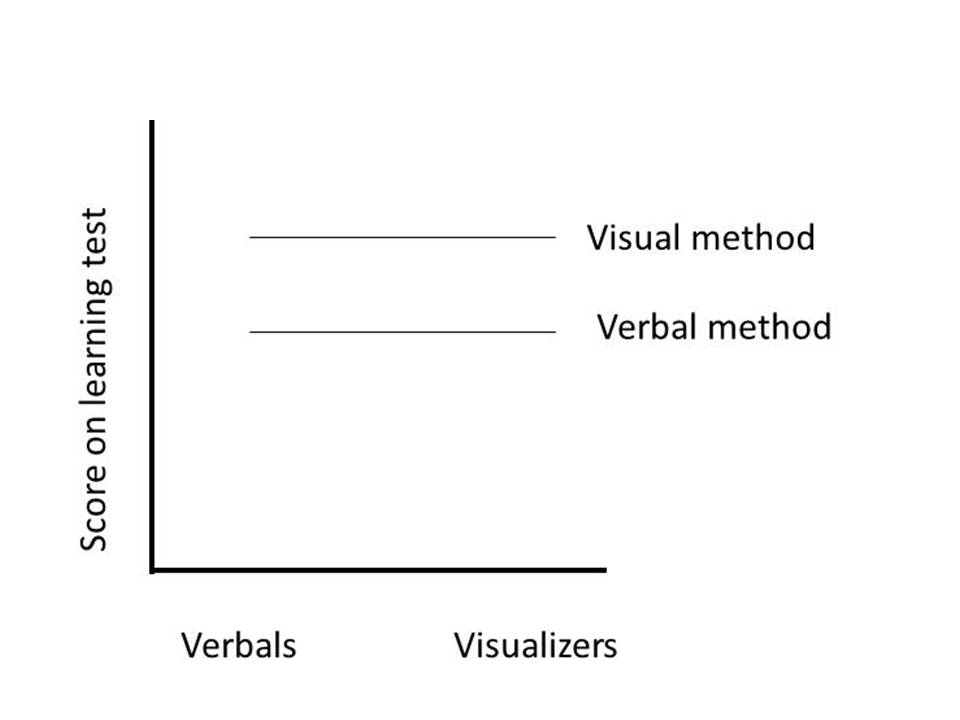
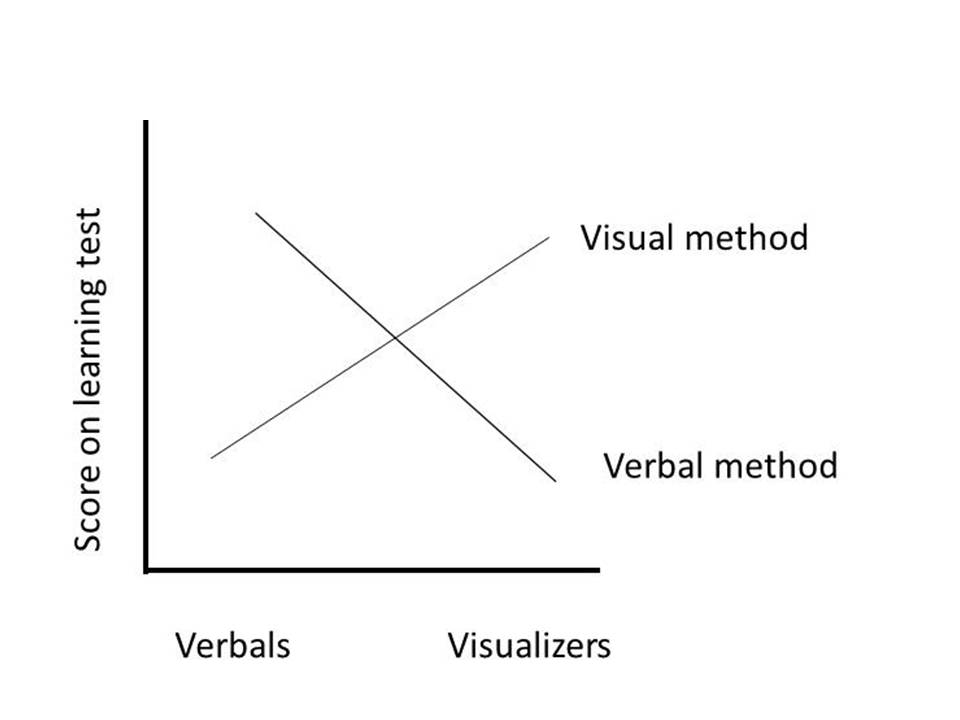
    Here’s a neat little experiment and accompanying visual that Richard Mayer reports in his book, Applying the Science of Learning. They first asked students a questionnaire to have them self-assess whether they were visual or verbal learners, and the strength of their preference. (e.g. “strongly more verbal than visual” compared to “slightly more visual than verbal”). They then taught a lesson to two randomly chosen groups, one in a verbal style and one in a visual style.

    If the phenomenon does work, you would expect results to look something like this:


    Instead, this is what the actual results looked like:


    The first conclusion that can be drawn from these results is that even if Dick sees himself as visual, and Jane considers herself to be a verbal learner, they both learn the same amount, under either teaching style.

    The second point is that the visual method results in greater learning, regardless of personal preference. As you can see, we are all visual learners.

    Why should a salesperson care about this? There’s enough to keep track of in a sales conversation without spending valuable bandwidth worrying about the customer’s learning style and trying to change pick the right word to suit. Forget these tricks, and focus instead on sincerely understanding the customer’s needs and motivations, and on clearly explaining the value you bring.

    I trust you hear my message loud and clear, that you see what I mean, and that you can wrap your arms around this concept.

  • The Three Minute Presentation that Helped Save the World

    A man of few words but huge influence

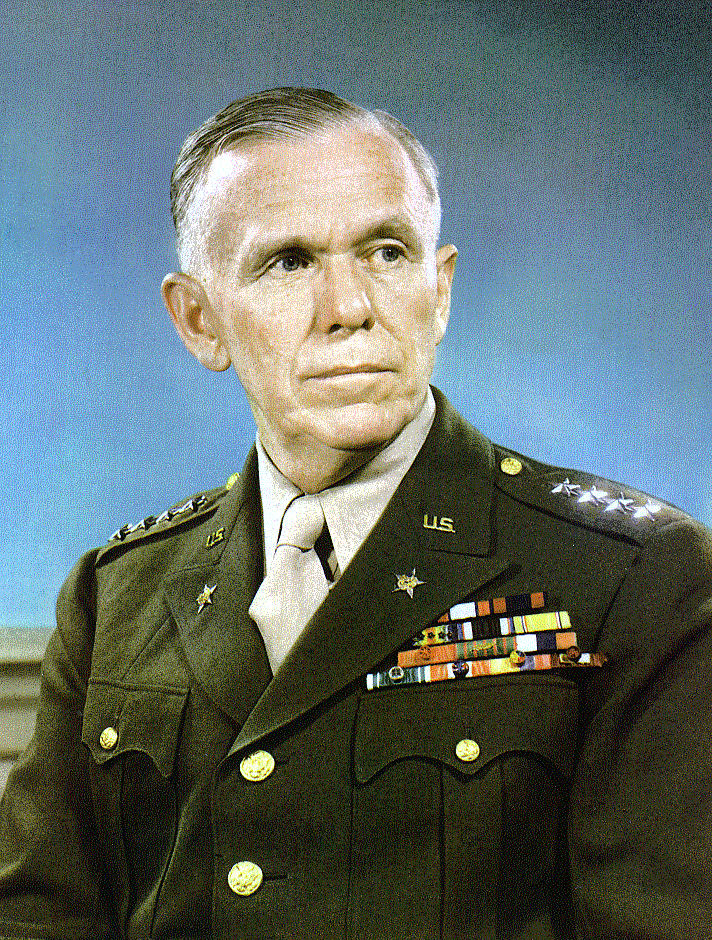
    On May 13, 1940, as the Western front was reeling under Hitler’s blitzkrieg attack on France and the Low Countries, the United States had a small third-rate army, equipped with obsolete weapons. The new Army Chief of Staff, George Marshall, was trying to change that, but President Roosevelt wasn’t buying.

    That morning, Marshall accompanied Treasury Secretary Henry Morgenthau, according to the story as told by Thomas Ricks in The Generals: American Military Command from World War II to Today, to the White House to make the case for a major increase in spending to build up the military. Roosevelt made it clear that he did not want to talk to them, and after Morgenthau spoke in support of the measure, Roosevelt cut him off and said, “Well, you filed your protest.”

    Morgenthau then asked the President to listen to Marshall, but FDR said, “I know exactly what he would say. There is no necessity for me to hear him at all.” Others in the room sat quietly, offering no support. As the meeting ended, Marshall approached Roosevelt’s desk and said, “Mr. President, may I have three minutes?”

    The President assented, and then began to say something else, but Marshall, afraid that he might not get to speak, spoke right over him. He spoke rapidly, full of facts and figures, saying, “If you don’t do something…and do it right away, I don’t know what’s going to happen to this country. You have got to do something, and you’ve got to do it today.”

    At this point, he had FDR’s full attention, and he went on: “We are in a situation now where it’s desperate. I am using the word very accurately, where it’s desperate.”

    It must have been a powerful presentation, because the next day, Roosevelt asked Marshall for a list of what the military needed.

    What can we learn from this extremely short but momentous speech? That sometimes it is possible to dramatically alter the listener’s attitude and position quickly if that’s the only chance you have. You too, can pull off this feat, as long as you have:

    Command of the facts: It begins with content: your proposal has to be grounded in reality, and you must have the facts to back up your position. You must command your material so well that without overwhelming the listener with detail, you leave no doubt that you have all the details if needed. Besides being convincing, facts also provide a face-saving way for the listener to change his mind. When it’s about opinions, it’s hard to change someone’s mind because it can get personal.

    Conviction: Conviction is not the same as passion, which is easily dismissed by the listener as purely emotional. Conviction comes from a solid foundation of thought, and the deep belief that your cause matters. It certainly contains a strong core of emotion, but that emotion may actually be more powerfully expressed by keeping it in check.

    Courage: It takes tremendous guts to stand up to the President of the United States, but Marshall had the character and devotion to duty that in effect left him with little choice. But the collateral benefit of having the courage to state the truth to power, even when it can be personally very costly, is that it can confer tremendous credibility.

    One final thought: Marshall already had a reputation in the Army for his ability to boil down complex issues to succinct statements. It was a skill he had honed over years, and it paid off for his country when it was needed most.

  • A Concrete Proposal to Make You More Persuasive

    Strong presentations are built of these

    Have you ever heard someone (perhaps even yourself) say something like, “our best-in-class quality and performance provide superior value that leads to unparalleled increases in productivity for our customers”?

    Try to picture each of these words in your mind. You can’t, because they aren’t real or tangible. There’s nothing “wrong” with words like quality, performance and productivity, but you’re not doing yourself a favor if your conversations don’t use words that listeners can see, hear, feel, taste, or smell.

    What do you give up when you lose concreteness?

    When you give a presentation, or just have a conversation to persuade someone, you want your listeners to: listen, understand, believe, imagine and remember. Here’s how being more concrete can help:

    Listen: People can’t be convinced if they don’t pay attention. Business abstractions such as quality, synergy, world-class, are used so often that we automatically block them out as meaningless buzzwords, while concrete words have the power to grab the listener by the shirt and force them to listen. You can talk about quality, or you can give a dramatic demonstration of it, by showing how beautiful or how tough your product is.

    Understand: It’s tough to convince people who don’t understand your ideas. When we first learn about something, we learn about real objects, and then we gradually climb the ladder of abstraction. When everyone in the room shares a high level of knowledge, abstraction is efficient and can convey credibility. But when you’re selling an idea to someone, they typically don’t know as much as you do about it, so there’s always a danger that you will be more abstract and vague than you need to be.

    Believe: One of the best ways to earn credibility is to show that you have been there and done that. Those who have, talk about real events, real people, and real things, not airy abstractions. You can mention customer complaints, or you can name a specific customer and share the language they used. Being specific is another aspect of concreteness, which is why even numbers can be used to make something more real. You can say your solution speeds up their process, or you can tell them it makes it 17% faster, which translates to $3.4 million in additional revenue.

    Imagine: You are much more likely to be killed by a deer bounding across a highway than by a shark, so why do you think about sharks when you swim in the ocean but don’t worry about deer when you drive? Maybe it’s because the mental picture of having your living flesh ripped from your bones as the water turns red around you is a bit more vivid than a collision with a moving object.

    People act on your ideas because they want to move away from pain or toward gain, and they are more likely to move when they can actively imagine the pain or the gain. Imagining real pains gets the motor running, and envisioning the future can get the wheels moving in the right direction. King’s Dream speech is memorable and inspiring because he helped an entire nation picture a better future. On a more mundane level, research has shown[1] that concrete and specific implementation intentions are much more likely to be carried out than general desires.

    Remember: Unless someone is making an immediate decision, which is unlikely in a complex sale, they’re going to have to remember what you said when they weigh the pros and cons. They will remember things and sensations more than they will remember concepts, especially when everyone is using the same concepts (quality, value, etc.) in their presentations.

    How about a concrete example?

    When Boeing designed the 727 in the 1960s, they could have told their engineers to design a best-in-class, high quality and high performance airplane. Instead, they told them to build a plane that could carry 131 passengers nonstop from Miami and land on runway 4-22 at La Guardia (because it’s a short runway).[2] Besides making it clear for the engineers, do you suppose it made it easier to sell to the airlines?


    [1] An excellent description of implementation intentions research can be found in Succeed, by Halvorson.

    [2] The story came from Made to Stick, by Chip and Dan Heath, although they got it from Built to Last, by Collins and Porras.