The father of all persuasive communication, Aristotle, taught that persuasion results from a combination of logos, pathos and ethos, and that ethos is the most important persuasive device.
While I believe this is not necessarily true in all persuasion situations, it is definitely true that who you are perceived to be by your audience is a huge factor in the success of your persuasive efforts. Their readiness to listen and to act on what they hear is powerfully affected by their perception of you as the messenger, and that perception is situational: it depends on your fit with that particular audience’s expectations for your particular topic.
Ethos often works not only by credibility but also by inspiration. If the audience looks up to the speaker, they want to be like him or her; they want to gain by association and agreement with his views.
Ethos gains special importance from the fact that it begins to work on the audience before you open your mouth. How you appear, what they know about your reputation and credentials, even the way you approach them, all send loud signals that affect how they will respond to your words.
In sales and marketing, we see that ethos can even affect how objects are perceived. A well-established brand influences how potential buyers perceive a product. Commodities can be turned into sought-after treasures simply by carrying a certain brand. Even price can be a form of ethos. An expensive bottle of wine has a different ethos than a cheap one. It works in reverse as well—many people refused to buy BP gasoline after the Gulf oil spill in 2010.
Although it seems like a simple concept, ethos is a product of many elements, including your appearance, credentials, motives and actions.
Appearance: It helps to be attractive, and it helps to fit the audience’s expectations. It’s unfair but true that attractive people are also seen as smarter and more likeable, which definitely helps their persuasiveness. Appearance can also be affected by what you wear. Robert Cialdini showed in experiments that people wearing suits were given more respect and achieved greater compliance with requests, for example.
But appearance is not all-powerful, as was demonstrated last week by Bobak Ferdowski. Who would have picked this guy for a NASA flight director?
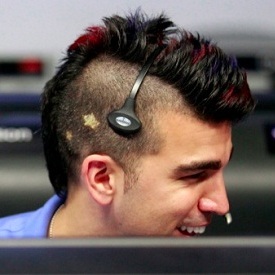
Credentials and reputation: Ferdowski’s credentials as a NASA flight director far outweigh the audience’s expectation of what a flight director should look like. Credentials are a form of brand. A Harvard professor speaking about a topic in her area of expertise will automatically be accorded greater credibility than someone with less impressive academic credentials.
While credentials are about qualifications, reputation is about your qualities: who you are, what have you done,and how you have done it. I recently taught a class to a group of engineers, all of whom had advanced degrees from top schools. They told me that, within their company, they pay very little attention to where someone went to school, but a lot of attention to which projects they’ve been involved in; the more prestigious the project, the more prestigious the engineer.
The irony of credentials and reputation is that if you spend too much time emphasizing them, you may come across as either defensive or boastful. You’ll be better off if you can get your introducer to say something about you.
Motives: Any time you’re trying to “sell” ideas, your listeners will be more receptive if they feel you share their values, and will be sensitive to your motives. Although they know you will benefit somehow if they acquiesce, try to make your message as listener and customer-focused as possible by couching it in their language and in accordance with what they value. But don’t carry this too far: when the benefit is entirely on your side, be up front about it. Sometimes a heartfelt, “I need your help” goes further than a listing of advantages and benefits.
Action: During spoken communication, ranging from face-to-face to large keynote speeches, the speaker’s actions, such as their tone of voice, facial expressions, stance and gestures all contribute to the ethos component of persuasion. The main keys here are to be authentic and confident.
In my own work as a presentations trainer, ethos is especially dependent on actions. If I tell my students that they must carry themselves or express themselves in a certain way, you can bet that they will immediately notice when I don’t follow my own rules. Do as I say, not as I do, does not work for presentations trainers.
What applies to presentations trainers actually applies to anyone: who you are and what you do often speaks much louder than what you say. Don’t just say it—be it.