Category: Persuasive communication

  • Leading Without Authority, Especially When You Have Plenty

    Do you wear your authority for all to see?

    Congratulations, you’re now in charge. Maybe you’ve been promoted to sales manager; or maybe you’re now a general manager or even CEO. With all that newly-issued authority, things are going to be much easier—no more selling for you; now you can just tell people what to do and it will get done, right? You get to set the vision, craft the strategy, and make the big decisions; everyone else’s job is to get on board and make it happen.

    If so, you’re making the same mistaken assumption that Dwight Eisenhower did. After a lifetime in the military, he was used to issuing orders and being reasonably confident that they would be followed. As President, he found that the order was only the beginning, not the end. If so, you’re making the same mistake that I’ve seen in some sales organizations I work with. When I warn sales leadership that implementing a new sales methodology can be difficult, most of them confidently tell me that they will mandate its use, as if that is all that needs to be done.

    Authority is like a life jacket. It will keep you afloat in a pinch, but if you need it, you’re already in trouble. And when you’re not in trouble, it just slows you down. Although safety experts recommend that you keep an actual life jacket on or nearby at all times while on the water, leaders should reach for their authority only as a last resort.

    The old “Because I said so” model just does not work anymore. It might have worked when managers did the thinking and employees did the manual labor (and even then it had its limitations), but today almost everyone is a knowledge worker, and often they know more than you do about their jobs. Smart bosses surround themselves with even smarter people, but smart people don’t want to be led by you or anyone else—they want you to create the conditions where they can do their thing without being bothered.[1]

    There’s also a big generational shift going on. Millenials are much more likely to question why they should do something. With jobs being scarce, they might keep their questions to themselves, but you can be sure that if the question is rattling around in their minds it can drag down their performance.

    Finally, in today’s business environment things are too complex, and are moving and changing too fast for any one person to know and control everything. You simply can’t be there to exercise your authority when people need to decide and act; you have to trust them to act on their own initiative, in line with your strategies, intentions, and values.

    Authority may in the short run get you the performance and effort you demand, but only persuasion gets you discretionary effort, where people do more than asked because they want to, not because they have to. Only persuasion works when you’re not around, or when you run out of sticks and carrots.

    So, what does this mean to you? In short, you still need to sell, explain, and inspire. The tools that you use to persuade are more important than ever.

    Listening: If you’re the boss, you need to listen more, not less. Research shows that people in authority tend to discount others’ advice[2], and 360° feedback programs show that leaders rate themselves as much better listeners than their subordinates do. Are you learning from others, or do you think you know it all? Are you making it safe for others to disagree or to bring bad news?

    Asking: Are you immediately solving problems, or are you asking questions to help people solve the problems themselves? Are your questions driven by genuine curiosity, or are they directives dressed as questions? (Leading questions are bad, don’t you agree?)

    Telling: Are you communicating frequently? Are you framing your communications in terms that tap into intrinsic motivation? Are you clear? Do people know where they stand with you? Are you consistent?

    Acting: Do your actions match your words? Are you setting the example that you want others to follow? Do you follow up on what subordinates tell you?




    [1] See the excellent article, “Leading Clever People”, by Rob Goffee and Gareth Jones, Harvard Business Review, March, 2007.

    [2] “Power, competitiveness, and advice taking: Why the powerful don’t listen,” Tost, Gino, Larrick, 2012.

  • Why Communication Is a Hard Skill

    Where did the failure occur?

    Communication is often viewed as one of those “soft” skills that every reasonably educated person should already be good at, especially managers and senior leaders who have been around for a while. If that is true, why do so many management strategies and plans go undone? Why do so many good ideas and great products go unsold? Why do we have so many failures to communicate?

    I recently came across the following, which was attributed to Konrad Lorenz. It’s quite profound, and is itself a wonderful example of clear and concise communication.


    1. What is thought is not said
    2. What is said is not heard
    3. What is heard is not understood
    4. What is understood is not believed
    5. What is believed is not yet advocated
    6. What is advocated is not yet acted on
    7. What is acted on is not yet completed

    Is it possible that communication is actually one of the hardest skills of all?

  • Your Message Does Not Belong to You Anymore

    Clueless

    Tom Morello, the guitarist for Rage Against the Machine, is not happy that Paul Ryan likes his band. Morello says Ryan “is clueless” about the band and what its lyrics stand for.

    I’m even more clueless, because until today I had barely heard of RATM, and had never heard of Morello.

    But the most clueless in this scenario is Morello, along with so many other entertainers who get upset when “the wrong people” like their music or when they take meaning form their lyrics that was never intended. Springsteen is embarrassed that Chris Christie is one of his most ardent fans, and while I love Jimmy Buffett and would love to sit down and have a margarita with him, I would be very careful not to discuss politics. (Although we do agree on manatees.)

    Here’s a newsflash for musicians—and for everyone else: once the message leaves your lips, it doesn’t belong to you anymore.

    Your message does not belong to you anymore. Once your message hits your listeners’ brains, it ricochets wildly around their existing attitudes, models and memories, finally coming to rest who knows where. Communication is about your listener. Every listener is different from you in some way, so there is always a certainty that they will interpret your message at least slightly differently than you intended. Multiply that by thousands of fans, and you have an almost infinite number of varied interpretations.

    Would Jesus recognize the interpretation of his message today? Would Lincoln, or Gandhi?

    So, what does this mean to you as a communicator?

    • Unlike a rock star, you can make the effort to learn and understand as much as possible about your audience to make sure your message is tailored for the best fit.
    • Unlike a rock star, you have the advantage of being able to pay attention to your listener, to ask questions, or to reframe or rephrase your message as necessary.
    • Unlike a musician, you’re not solely in transmission mode all the time—or are you?
  • Communication Abroad: Three Resources for Cultural Sensitivity

    You mean, we have a choice?

    I’m getting ready to go to Japan and China to run some classes, and since I haven’t been there in a couple of years, I’ve gone back to some trusty resources to help me ensure that I can speak the language of my listeners. No, I’m not referring to actually learning Japanese and Chinese, but I do want to make sure that I am sensitive to the thinking and communication styles of my hosts and students.

    As the world becomes increasingly global, it becomes more and more important for communicators to be aware that there is no one best way of thinking and communicating, and unless you get at least a passing familiarity with other cultures, you are at best leaving effectiveness on the table and at worst at risk of committing a serious faux pas.[1]

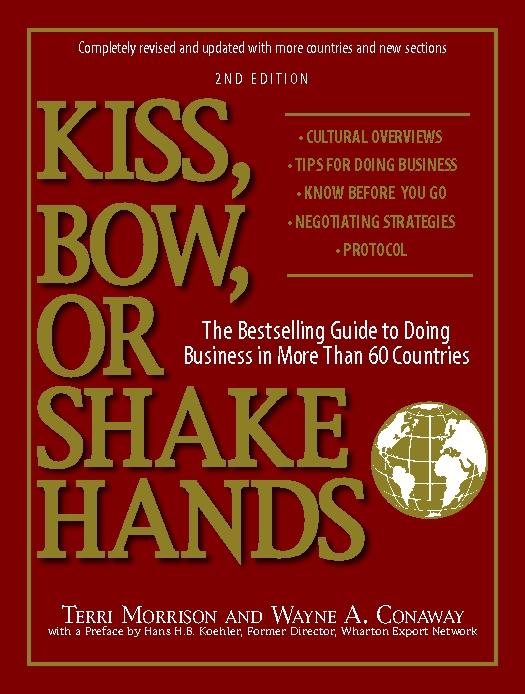
    When I first went to China about fifteen years ago, I had the good fortune to read a book called Kiss,  Bow, or Shake Hands . It was good fortune because it provided practical advice that definitely helped me. I was at a dinner with all my hosts, when one of them said, “Mr. Malcolm, I would like to drink a toast to you,” with a shot glass of mao tai. Fortunately, the book had prepped me for this, and I replied, “I would be honored if everyone would join in.” If I had not done that, each one in turn would have proposed a toast, and I would have ended up with about 12 shots, while of my hosts only had one. As it was, they stopped toasting after about the third shot. Who says you can’t learn anything practical from books? This one covers 60 different countries, so it’s a useful resource if you travel a lot.

    While that book is still an excellent resource for customs and behaviors, another resource I’ve found to be very useful is Professor Geert Hofstede’s cultural dimensions website. Based on research he did for IBM during the 1970s, Hofstede isolated five cultural characteristics and measured the degree to which they apply to various countries (the definitions are my own, and are vastly simplified).

    • Power distance: the amount of respect and acceptance that lower ranking people give to those of higher rank.
    • Individualism: the amount of emphasis on group harmony vs. individual needs.
    • Masculinity: emphasis on competition and achievement, vs. the feminine values of modesty and caring.
    • Uncertainty avoidance: the amount of tolerance for ambiguity and unstructured situations.
    • Long-term orientation: this dimension was added later, and describes the extent to which the members are willing to defer rewards.


    It’s tough to go into too much detail in a short article, but I have found it helpful to, first, check out the US measurement for each characteristic, and then compare it to that of the country to which I am traveling. From Hofstede’s web site, here are the measurements for the three:


    USA JAPAN CHINA
    PDI

    40

    54

    80

    IND

    91

    46

    20

    MAS

    62

    95

    66

    UAI

    46

    92

    30

    LTO

    29

    80

    118


    The web site also has a written explanation for each country that you might find helpful.

    Understanding others often begins with understanding yourself, so a third resource that I’ve used and liked is Americans at Work: A Cultural Guide to the Can-Do People, by Craig Storti. It’s written to help those from other cultures understand us, and it makes for fascinating and sometimes uncomfortable reading. For example, did you know that many cultures consider that American managers don’t have good people skills? They consider us too direct, impatient and driven to truly understand the nuances of relationships and conversations. Our tendency to take things too literally leads to misunderstandings, as in this example:


    BILL: We need to schedule the next team meeting.

    HIROKO: Good idea.

    BILL: How about next Tuesday morning?

    HIROKO: Tuesday?

    BILL: Yes, would 10:30 be OK?

    HIROKO: 10:30? Is it good for you?

    BILL: Yes, it’s fine.

    HIROKO: I see.


    After this exchange, Bill confidently enters the meeting date into the calendar, but Hiroko thinks he has made it quite clear that the meeting time is not good for him. He never directly answered Bill’s question, and never said yes.

    Although these resources make for fascinating and useful reading, it’s important to keep in mind that they all address averages, not individuals. You can always find impatient Chinese, subservient Americans, and spontaneous Japanese, so don’t try to force-fit everyone you meet into a number.

    Secondly, I haven’t seen research along these lines, but in my own travels I’ve noticed that frequently corporate culture exercises greater influence on how people think and communicate than national culture. I saw a dramatic demonstration of this in Japan two years ago, when I worked with two different companies in the same week. In the first, my audience consisted of salespeople, and they fit the Japanese image very closely. Later that week, I trained some engineers who were as open and challenging in the classroom as any American group I’ve worked with, shattering two stereotypes in the process.


    [1] That’s a French term loosely meaning, “get out and stay out, you ignorant foreigner.”