There are hundreds of books written on leadership every year, most of which claim to analyze and isolate the traits that make someone a good leader, as if there is a secret formula for leadership that can be bottled and sold. The fact that each book’s secret formula is different does not seem to deter the writers or their readers.
There is no secret formula or combination of traits that will make anyone the best leader, and an excellent illustration of this can be found in Walter Borneman’s new book, The Admirals, which chronicles the careers of the four American admirals who achieved five-star rank while leading our nation to victory in WWII.
The highest ranking (by design, he was the first promoted to the new five-star rank, so that he would have seniority), most influential, and least heralded was William Leahy, who served during the war as FDR’s personal military adviser. (more…)
In working on my new book, Strategic Sales Presentations, I’ve shared the manuscript with some colleagues and friends for their perspective. Their feedback has been almost uniformly complimentary, and they’ve further inflated my own opinion of the value of the book, its content, and its writing.
BUT, I just received comments from a more objective reviewer who does not have personal ties to me. His comments back to me initially echoed some of the same praise I’ve grown accustomed to receiving, but then he launched into what he saw as the shortcomings. Let me tell you, it was painful to read—yet it was exactly what I needed to hear.
He made three suggestions which make a tremendous amount of sense and which in retrospect seem obvious. They were not obvious to me, probably because I was too close to it. I suspect they were obvious to previous readers, though, and if I shared the latest reviewer’s comments with them, they would probably say they agree as well. Yet, they never said anything to me. Maybe they were trying to be tactful and spare my feelings, or maybe they did not want to feel uncomfortable themselves.
Sometimes compliments are the easy way out. We don’t want to put ourselves in the uncomfortable position of making someone else uncomfortable, so we choose the path of least resistance, in which case we’re making it as much about ourselves as we are about the other person.
It reminds me of a lesson I learned early in my sales training career. I was facilitating some role plays and one of the participants did a very poor job. Not wanting to hurt his self-confidence, I performed all kinds of verbal gymnastics trying to find something good to say about his performance. Immediately one of the other participants called me out on it; he rightly pointed out that my feedback was worse than useless, and that I was not doing the job I was being paid for.
I was trying too hard to apply a feedback sandwich, in which you sandwich your improvement suggestions between two positives. This is designed to preserve the self-esteem of the one being corrected. Yet, maybe sparing someone’s feelings is exactly the wrong approach. Of course, you don’t want to be brutal or gratuitously harsh, but by trying to soften the emotional impact are you not harming the learning process? Touching a warm stove may or may not teach you a lesson, but touch a hot one stove, and you’ll never forget the lesson.
Second, how often do we strive so hard to be “constructive” that we lose clarity, directness and honesty?
Third, the sandwich approach may also backfire, because our natural confirmation bias disposes us to hear only what we want to hear and disregard the rest.
So, if you really want to be a friend, if you really want to help, give them something useful and be direct. Of course, if you don’t care that much, you can always take the approach that my friend Gary Connor did. He was at a conference and listened to an excruciatingly bad presentation. Immediately afterwards, the speaker asked him what he thought. Gary’s reply: “Of all the presentations I heard today, yours was definitely the most recent.” The speaker beamed and thanked him for the feedback!
Last week I went on a little rant against those who tell us that in this Google Age it’s not important to stuff your head with facts. I showed how on having a deep well of knowledge to draw from is so critical for effective thinking. But what about persuasion? Compared to clear thinking and compelling communication, it would seem that having a lot of facts at your command would seem to be relatively less important. In this article, I’d like to show that depth of knowledge is a huge asset for persuasion as well.
Regular readers know that one of my key themes is that content is king. It’s wonderful to have a gift of gab and to know how to pull all the persuasive strings, but without a lot of facts at your immediate command, you can look like a fine pen that is running out of ink.
Unless you make a living as a writer, most of your persuasion is real time, so you’re not going to have time to look up the information you need to support your point. In a dialogue where two people are trying to influence each other, the one who has the necessary facts at their command when they need them is likeliest to prevail.
Have you ever seen someone deliver a slide presentation and look at the slides most of the time? They use them as a crutch and a memory aid for their “talk track”, and it’s obvious that they don’t have full mastery of the material. Yet, they’re trying to talk you into something based on that material. The content may be airtight, but yet it’s unconvincing; they come across as content mercenaries, fighting for someone else’s ideas.
If you’re a salesperson, it’s especially because knowledge is so readily available that you have to “add value” and that is in the form of proprietary knowledge. You are the one who knows how to diagnose needs (which require a much deeper knowledge and analysis than wants). The customer knows about his or her own business operations and processes, and they can look up and compare product specs easily enough, but you make a living with your special expertise that connects those two pools of knowledge.
Having a facile and fluent command of facts and detail has a strong subliminal effect in its own right. Knowledge is impressive. We admire those who have a deep grasp of their topic, who can pull up concrete and specific facts to support their arguments. On the flip side, we see this every political season, in which an inexperienced candidate is lambasted in the press for not knowing the name of a key foreign leader, for example.
Deep knowledge can also make your communication more compelling by adding specificity and concrete detail. It’s one thing to say that your product makes your customer’s business process more efficient; it’s far better to say, “We speed up the reconcilement process by 35%, which cuts an average of four days out of your accounts receivable.”
Want to impress an audience, especially one comprising senior level executives? Then tell them something new and be prepared to deep dive, both of which require you to know a lot. When you’re presenting to an audience, it’s often the detailed grasp you can demonstrate during the Q&A that will convince the listener. When I interviewed senior executives for my book on sales presentations, several of them told me that they like to “scratch beneath the surface” of the presentation to test the presenter’s depth of knowledge. If it’s a technical presentation, they may not personally have the knowledge to assess everything that’s told to them, so they use this tactic as a gauge of the presenter’s credibility.
There’s a cute story about the physicist Max Planck, who used to travel around Germany delivering physics lectures. One day his chauffeur made an interesting proposal: he said they should trade places at the next lecture, since he had heard the lecture so many times that he was sure he could deliver it word for word. Planck agreed, and the plan proceeded. Everything went perfectly, until the question and answer period, when a distinguished professor asked a difficult question about some esoteric detail in the lecture. The chauffeur, without skipping a beat, said: “Herr Professor, I am surprised that someone as knowledgeable as yourself would ask such a question. To prove how simple it is, I will let my driver answer it.”
Unlike Planck’s driver, you probably won’t have the luxury of someone sitting in the audience to bail you out, so you had better become that expert.
I bet you never thought you would learn about one-celled organisms in a blog about persuasion, but bear with me for a few paragraphs because I want to make an important point.
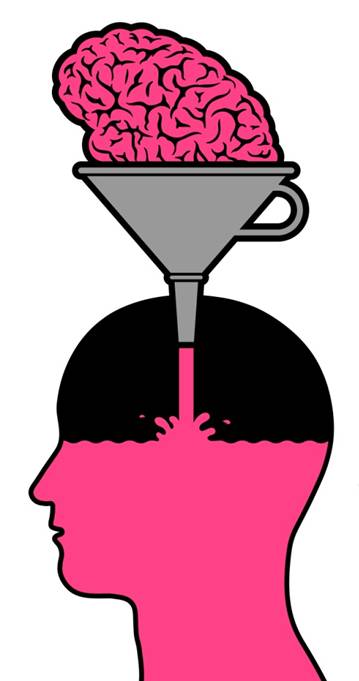
It’s been quite the fashion over the past few years in sales and persuasion circles to focus on our three brains: the reptilian brain, the rat brain, and the human brain. The idea is pretty simple: our human brains have evolved over eons in a different environment than our modern world; since evolution by definition proceeds from what went before, as our newer brain structures and functions evolved, the old structures remain and continue to be quite active. It’s kind of like the separation of powers in the Federal government: all three branches get involved in the process. So, if you want to persuade someone, you have to appeal to the simpler brains as well as to our logical faculties.
That may be true, but why stop at the reptile brain? If we trace our ancestry even further, we all evolved from one-celled organisms—amoebas, if you will, and we were amoebas even longer than we were reptiles. So, should we also tailor our persuasive efforts to the amoeba brain that surely lurks within all of us?
I can see it now: make sure you have a lot of light when you make your presentations, because amoebas move toward the light. You wouldn’t have to explain your solution, because people can get it by osmosis. We could call it “celling”. I realize I’ve reached the point of absurdity, but unfortunately so have many of the “scientific” persuasion experts.
The basic idea is sound, as long as it’s not carried too far. Aristotle, the father of modern persuasion science, made it the core of his Rhetoric, acknowledging that persuasive appeals comprise three strands, ethos, pathos, and logos. More recently, research has categorized and measured myriad ways in which our decisions and behaviors deviate from the purely rational. Science has learned a lot about the brain in the past few decades, and technologies such as functional MRIs let them see real time into our brain activity as we make decisions, respond to stimuli, etc. A lot of that research has confirmed, refined, or changed our understanding of how our minds work.
But new scientific discoveries are inevitably seized upon immediately by modern-day snake oil salesmen to add some legitimacy to their half-baked ideas. The ink was barely dry on the first edition of Darwin’s Origin of Species when the Social Darwinists hijacked his theories to justify their own notions of how society should be organized. In the same spirit, a lot of experts have picked up on the colorful pictures showing various areas of the brain lighting up during controlled laboratory experiments to market their services to companies, promising that they can read consumers’ brains and know what makes them tick, even better than the consumers themselves can. (By the way, if you’ve ever been inside of one of those machines, you know just how “natural” that situation is.)
When a book applies the idea to B2B sales, telling us that, “In spite of our modern ability to analyze and rationalize complex scenarios and situations, the old brain will regularly override all aspects of this analysis and, quite simply, veto the new brain’s conclusions.”[1], then the idea has gone too far.
I have a lot of respect for the work of one of the deans of persuasion science, Robert Cialdini, but even he goes a little too far. His six principles for influence are implied to be so powerful that you can’t sell a good idea without them, and you can definitely sell bad ideas with them. You can trigger fixed-action patterns that cause people to act like a mother turkey does when she hears “cheep-cheep”, and that’s what his book is about.[2] Cialdini at least acknowledges the importance of rationality—in a footnote—saying of course material self-interest is important, but that it goes without saying.
Yet, that’s the problem: it doesn’t go without saying. When a Harvard Business School professor tells us that “what you say is less important than how you say it”, and “style trumps content”, then it has to be said.
Content has to come first
This article is a plea for a little more, well, rationality in the understanding of what it takes to get ideas approved and products sold. Of course it’s important to be able to appeal to more than just the rational parts of the brains of your persuasive target. I’ve written about ways to do that many times on this blog. But it has to start with a sound, logical and defensible business or personal case—with what Cialdini called material self-interest.
One of the oldest sayings in sales is that you should sell the sizzle, not the steak. But what happens when they buy the appetizing sizzle and then find out the steak is crappy? They won’t come back. That’s why you have to make absolutely you have an excellent steak before you worry about the sizzle. Regardless of how many persuasive cues you employ, or which regions of the brain turn which color in the fmri, if the idea does not work, you soon won’t, either. Bad ideas are bad ideas, no matter how they’re dressed up.
One problem with fixation on techniques to appeal to the old brain is that they distract from the main job of putting together a strong proposal. There are people who spend most of their time learning “the tricks of the trade” in the hope of finding shortcuts, when they should be learning the trade itself. I’ve seen people put more time in the choice of fonts for their slides than they do in critically examining the strength of their ideas.
Whether you’re trying to get a proposal approved internally or selling a solution to a customer, most business decisions are complex enough to require extensive data, deep analysis, and careful decisions. That’s the reality of our modern world, which was built by the human brain. Never forget that it’s still the most important decision maker.
[1] Patrick Renvoise and Cristophe Morin, Neuromarketing, viii.
[2] Robert B. Cialdini, Influence: Science and Practice.